







Rose, Rose, I Love You (Song)
From Wikipedia, the free encyclopedia
| “Rose, Rose, I Love You 玫瑰玫瑰我愛你” | |
|---|---|
| Single by Yao Lee | |
| from the album Singing Girl | |
| Released | 1940 |
| Recorded | 1940 |
| Genre | Mandopop, shidaiqu |
| Length | 2:23 |
| Label | Pathé Records / EMI |
| Songwriters | Chen Gexin, Wu Cun (吳村) |
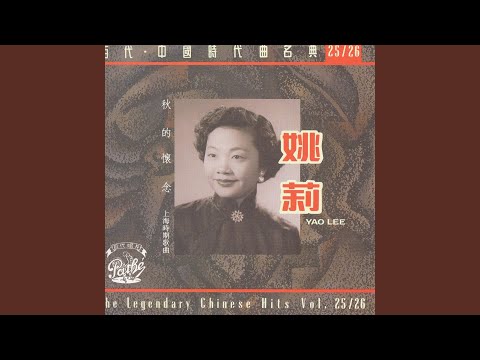
“Rose, Rose, I Love You” (Chinese: 玫瑰玫瑰我愛你; pinyin: Méiguì méiguì wǒ ài nǐ) is a 1940 Mandarin popular song composed by Chen Gexin and first recorded by Yao Lee. An English-language version whose lyrics have little in common with the original Mandarin was first recorded by Frankie Laine in 1951. The song was brought back to England by broadcaster Wilfrid Thomas in 1951 after doing commentary on the war in Malaya. When he played it on his BBC program he received a barrage of requests for a repeat and he played it again in several more programs. The song is also known under the titles “Shanghai Rose” and “China Rose.”
History

The original Chinese lyrics were by Wu Cun (Ng Chuen; 吳村 Wú Cūn) and the music was credited to Lin Mei (林枚), a pen name of the popular songwriter Chen Gexin. The song was first recorded in 1940 by Yao Lee as an interlude for the film Singing Girl and released as a single on Pathé Records (EMI) catalog number B. 597. Yao Lee’s Mandarin version was also released in the US and UK in the early 1950s by Columbia Records, catalog numbers 39420 and 2837 respectively. Yao Lee was credited as Miss Hue Lee on this release. Other early releases have also credited her as Yiu Lei.
The English-language lyrics were written by the British radio presenter Wilfrid Thomas. It was recorded by American singer Frankie Laine and the Norman Luboff Choir, with Paul Weston and his orchestra, on 6 April 1951, and released by Columbia Records as catalog number 39367.
The song reached number 3 on the Billboard music chart. At this time Columbia also released Yao Lee’s original Mandarin version in the US and UK under the English title, “Rose, Rose, I Love You”. When the songwriter Chen Gexin’s youngest son went to the United States for advanced education, he was able to meet Laine and maintained a correspondence. The English lyrics have little in common with the original Mandarin, but they pay subtle tribute to the titular Mandarin phrase “méigui méigui” (lit. rose, rose) by including the similar-sounding English phrase “make way” with its normal English meaning three times.
Covers
- Petula Clark covered the song in English with new lyrics under the title “May Kway”. This lyric entered the UK sheet music charts on May 5, 1951 and peaked at number 16.
- Japanese singer Kyu Sakamoto covered the original Mandarin versions in the 1960s.
- Gordon Jenkins released a cover of Frankie Laine’s version on Decca Records catalog number 27594.
- Aneka also covered Frankie Laine’s version in the early 1980s, also adding new original English lyrics. This single was released by Ariola Records but did not chart.
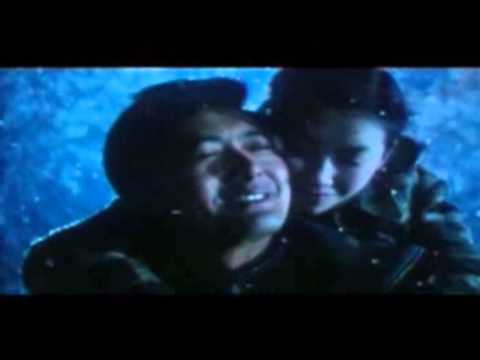
- Hong Kong singer Anita Mui sang the Cantonese cover of the song in 1989, and was featured as the theme soundtrack in Jackie Chan‘s film, Miracles.
- Malaysian girl group Four Golden Princess released an album of medleys (2006), each of which paired a popular Mandarin song with an English-language pop song. They covered the first two verses and chorus of the English-language version of “Rose, Rose, I Love You”, rather than the Chinese version.
- The original Mandarin version of this song was also covered by Taiwanese singer Joanna Wang on her 2009 album Joanna & Wang Ruo-lin.
- The Mandarin version has also reached a degree of popularity in Vietnam with various performers, such as Thu Ngọc
- and Thái Doanh Doanh, covering the song under the title “Cánh hồng Trung Quốc”.
- 鳳飛飛
- 林淑容
- 姚蘇蓉
- 潘迪華
- Fang Qiong 方琼
- 甄妮
- 老上海爵士樂團
- Zainal Alam
- Great World Cabaret
- 雅正薩克斯風二重奏
- Tien Chong
- 黄绮珊 #郁可唯 携
In popular culture
- The original Mandarin song was featured in the 1996 film The Pillow Book, both opening and closing the film and serving as a leitmotif representing the protagonist Nagiko’s childhood.
- It was also featured in the 2005 film The White Countess (the film appears to be set in 1937, so the inclusion of the song would be anachronistic).
https://youtu.be/Euhv0PUkDYw?si=WfrI5BA482zPXSn9
- Anita Mui sings this song in the 1989 Jackie Chan film Miracles.
- The Frankie Laine version was featured in Peter Bogdanovich‘s 1971 film The Last Picture Show.
https://youtu.be/Skvht5orpeA?si=4TJb0jHlKbzQTJyb
- David Bowie references the song in the 1984 documentary Ricochet. While visiting Hong Kong during his Serious Moonlight Tour, Bowie is filmed having dinner with a group of local socialites. He asks if they know the song, and several of the guests begin to sing it. At another time, the song is heard as a backdrop to footage of Hong Kong street life.
Rose Rose I Love You may also refer to the film.
Rose Rose I Love You (Film)
| Rose Rose I Love You | |
|---|---|
| |
| Traditional Chinese | 玫瑰玫瑰我愛你 |
| Simplified Chinese | 玫瑰玫瑰我爱你 |
| Hanyu Pinyin | Méi Guī Méi Guī Wǒ Ài Nǐ |
| Jyutping | Mui4 Gwai3 Mui4 Gwai3 Ngo5 Ngoi3 Nei2 |
| Directed by | Jacky Pang |
| Screenplay by | Wang Chen-ho |
| Produced by | Jeffrey Lau |
| Starring | Tony Leung Kenny Bee Simon Yam Carina Lau Veronica Yip Charine Chan |
| Cinematography | Chan Yuen-kai |
| Edited by | Hai Kit-wai |
| Music by | Lowell Lo |
| Production company | Regal Films |
| Distributed by | Regal Films Distribution |
| Release date | 27 March 1993 |
| Running time | 94 minutes |
| Country | Hong Kong |
| Language | Cantonese |
| Box office | HK$21,929,420 |
Rose Rose I Love You is a 1993 Hong Kong comedy film directed by Jacky Pang and starring Tony Leung, Kenny Bee, Simon Yam, Carina Lau, Veronica Yip and Charine Chan. The film is a sequel to the 1992 film 92 Legendary La Rose Noire, with Leung reprising his role from the predecessor, but features a new storyline.
It was followed by another sequel, confusingly titled Black Rose II, released in 1997, also featuring a new storyline and cast.
Plot
Thief Micky was arrested by police detectives Keith Lui and Leung Sing-po while attempting to steal a priceless diamond called “Star of Malaysia”. However, when this priceless gem goes missing, Micky frames Black Rose for stealing it, causing an uproar.
One night, Micky escapes from prison while Keith and Sing-po are ordered to bring him back to justice. The two had devised an ingenious scheme to get close to Micky’s ex-lover, Pearl Chan, to search for clues. Meanwhile, Black Rose disguises herself as a civilian under the name of Beauty and gets close to Keith to clear her name, which causes a lot of headaches for Keith. Micky proceeds to retrieve the key to the “Star of Malaysia” from Pearl, who turns out to be the incarnation of White Rose, Black Rose’s rival. Pearl has been investigating the whereabouts of the gem, but unbeknownst to her, the key is hidden in a necklace that she regularly wears, and Micky successfully retrieves the key. However, Mickyu’s girlfriend, Lulu (Charine Chan), turns out to be White Rose’s follower and tricks Micky into giving up the key. When Black Rose learns of this, she also proceeds to take the key and prove her innocence. At this time, Keith and Sing-po realize the true identities of their respective love interests, Beauty and Pearl. To get the key back, Micky ties a bomb around him and threatens to kill everyone.
Cast
- Tony Leung Ka-fai as Keith Lui
- Kenny Bee as Leung Sing-po
- Simon Yam as Micky
- Carina Lau as Pearl Chan / White Rose
- Veronica Yip as Beauty / Black Rose
- Charine Chan as Lulu / White Rose No. 3
- Bowie Lam as Tam Tak-cheung
- Ku Feng as Angry dad of Tam’s girlfriend
- Lo Hung as School headmaster / White Rose No. 2
- Tommy Leung as Keith’s superior officer
- Jameson Lam as White Rose’s gang member
Reception
Critical
Andrew Saroch of Far East Films gave the film a score of three over five stars and describes the humor as “surreal, yet often engaging in a kind of baffling way.” LoveHKFilm gave the film a mixed review describing the plot as not “making any sense” and also praising Tony Leung Ka-fai‘s comic charm.
Box office
The film grossed HK$21,929,420 at the Hong Kong box office during its theatrical run from 27 March to 30 April 1993.

























'))
Comments